FROM HSUS - Who doesn't melt when they see adorable puppies with red bows tied around them leaping about in a pet store window? In December, holiday shoppers find them so irresistible that they are eager to pay top dollar to surprise someone on Christmas morning with a cuddly pup under the tree. Buyer beware says The Humane Society of the United States.
According to Stephanie Shain, director of outreach for companion animals at The HSUS, "The puppy-under-the-tree scenario has a great image but the reality is not always as warm and fuzzy as we'd like to imagine. A dog is a precious purchase that will be in someone's life for an average of 15 years, so it should not be an impulse buy. And for consumers who insist on buying a dog as a gift, they should never -- under any circumstance -- buy one from a pet store where most of the 'inventory' come from puppy mills and you just might end up giving the gift of a very sick or dying animal."
She recommends the following holiday gift-giving tips for consumers wanting to give a healthy, happy dog as a gift:
Be practical: Consider giving a gift certificate covering the adoption fee at a local shelter, rather than choosing a dog for someone else. Wrap the certificate with a dog bowl and toys so there is something to unwrap. "Not as cute as a live puppy, but a much more thoughtful decision for the animal and the recipient." It is best to let the recipient pick out the dog they connect with, rather than you picking out the one that you connect with.
Do your research: Does the recipient have the time to exercise a dog daily? Are they ready for the expense of vet bills and any emergencies that will come up? Do they have time to train a dog? How do they feel about dog hair on the furniture?
Where to start: Once you determine that you want to give the gift of an animal for the holidays, shelters are the best place to start. One of four shelter dogs is a purebred, and adopting from a shelter will save you hundreds of dollars, and save a life.
Alternatives: No luck at the shelter but still want to buy a puppy as a gift? Number one tip, according to Shain, "Find a reputable breeder. A responsible breeder will NEVER sell a puppy to someone who they have not personally met. No one should purchase a dog without physically visiting where the puppy was born and raised. Pet stores and online dealers will tell you what you want to hear to move that puppy out and stock the cage with another."
Beware: Most dogs sold in pet stores – and via the internet -- come from puppy mills. Puppy mills are mass breeding facilities where dogs are crowded into cages and puppies are churned out with little regard to their health or to sound breeding practices. Mills often hide behind the "legitimacy" of a neighborhood pet store. The worst gift you can ever give is the puppy who looks fine when you pick her out at the store, then "crashes" after a day or two. "Your gift will end up costing the recipient thousands of dollars, not to mention Christmas heartbreak. It happens way too often around the holidays."
Free guide: To make this process easier for anyone looking to buy a dog, and for free information on adopting, rescuing or finding a reputable breeder, check out the new brochure "Puppy Buyer's Guide" from The HSUS. Visit www.puppybuyersguide.com or send your request to HSUS - Puppy Buyers Guide 2100 L St., NW Washington, DC 20037.
Tuesday, December 19, 2006


Spay/Neuter Clinic - Rascal Unit
As part of the local government, we wanted to be proactive in helping our citizens find an affordable means of vaccinating and altering their pets to help with our rabies and animal population issues. We found a wonderful solution in the form of the Rascal Unit (www.rascalunit.com). We brought in the unit for a Wellness Clinic in November and for a day-long altering clinic on December 2, 2006. The entire program was fantastic. The vet is a wonderful, caring vet, her team is very talented, and the surgeries went very well. The response from the community was tremendous and almost everyone has asked when they might be back.
As others who might be watching this blog know, there are special concerns when treating brachycephalics. I'm happy to report that 5 pugs and a boxer went under anesthesia and all did very well. The vet volunteered information to me about appropriate procedures for brachycephalics during our wellness clinic which put me much more at ease booking them into the surgery schedule. Two of the pugs were pups we had raised, so you know how high my confidence level was to allow them to work on our babies.
As others who might be watching this blog know, there are special concerns when treating brachycephalics. I'm happy to report that 5 pugs and a boxer went under anesthesia and all did very well. The vet volunteered information to me about appropriate procedures for brachycephalics during our wellness clinic which put me much more at ease booking them into the surgery schedule. Two of the pugs were pups we had raised, so you know how high my confidence level was to allow them to work on our babies.
Congratulations Gator & Patrick!
Congratulations to Gator and his handler, Patrick, for the first blue ribbon he's received at the 10-28-06 Delaware dog show!!
Rescues & Kennel Cough
One day in early July I stopped by the local humane society. The woman behind the desk was almost in tears. They had confiscated a pit bull puppy that was abused with firecrackers and run over by a truck. Amazingly, the resilient puppy had no broken bones, and they had nursed him to health and were waiting for a rescue group to take him. When it came time, the group didn't have enough room and turned him down. The girl had spent the better part of the day contacting other rescue groups, knowing that if she didn't find him a home soon, chances were good that he would never be given an opportunity in life. She finally found one, but he needed a home for 2 weeks before they could pick him up.
At first I said no, I have puppies at home. But then who could say no to a puppy who had been through so much? So I explained I have an unused outdoor kennel and as long as I picked him up from the vet's from neutering, he was welcome to stay there; it was the best I could do. He came to our home and was a very sweet boy. However, 3 days later his kennel cough kicked in.
Our dogs are vaccinated for kennel cough (bordatella), but through this experience I found that the vaccine covers 3 of the worst strains and that there are 52 strains out there, so it's still very easy to contract. In my research, I also found out that unless it settles deep into the chest and they appear to be sick, that it is best to let the illness run its course. Most of the dogs got a hacking that sounded similar to a cat coughing up a furball the firts day, then coughing for 1-4 days after that, tapering down to nothing. In this time, their attitudes were still good, they were playful and cheerful, just dealing with a hack or cough. One of them, though, had issues with it. He couldn't get a good cough, like he couldn't get enough air in to actually hack it back out. And he became reclusive and depressed, hanging his ears and trying to go outside and hide under the bushes. We got him into the vet as soon as they had an opening and they said he was just shy of pneumonia and we went through a round of antibiotics which did the trick.
Sometimes a dog will contract it and be rushed into the vet who will administer antibiotics for a normal cough. In general, if they are handling it well, they are better off fighting it and allowing the immunity to build. The immunity will last for a year against the same strain.
Unfortunately, the strain we had slowly worked its way through the dogs and I was afraid that the puppies would be exposed and/or contract it, so I kept them a few extra weeks. The good news is that they never got it! Evidently mom's colustrum was stronger! We kept them through their second set of shots, when they finally allowed us to also give the bordatella vaccine. It was important to us that they not get a cough, and if they did, that they weren't given a round of antibiotics unless it was necessary. I'm so glad it wasn't necessary. They are a group of strong, happy puppies with great dispositions.
We had lessons learned. I found some great homeopathic remedies for the cough. I don't regret helping save the puppy's life, but I'll definitely stay out of the humane society while I have little ones at home!
At first I said no, I have puppies at home. But then who could say no to a puppy who had been through so much? So I explained I have an unused outdoor kennel and as long as I picked him up from the vet's from neutering, he was welcome to stay there; it was the best I could do. He came to our home and was a very sweet boy. However, 3 days later his kennel cough kicked in.
Our dogs are vaccinated for kennel cough (bordatella), but through this experience I found that the vaccine covers 3 of the worst strains and that there are 52 strains out there, so it's still very easy to contract. In my research, I also found out that unless it settles deep into the chest and they appear to be sick, that it is best to let the illness run its course. Most of the dogs got a hacking that sounded similar to a cat coughing up a furball the firts day, then coughing for 1-4 days after that, tapering down to nothing. In this time, their attitudes were still good, they were playful and cheerful, just dealing with a hack or cough. One of them, though, had issues with it. He couldn't get a good cough, like he couldn't get enough air in to actually hack it back out. And he became reclusive and depressed, hanging his ears and trying to go outside and hide under the bushes. We got him into the vet as soon as they had an opening and they said he was just shy of pneumonia and we went through a round of antibiotics which did the trick.
Sometimes a dog will contract it and be rushed into the vet who will administer antibiotics for a normal cough. In general, if they are handling it well, they are better off fighting it and allowing the immunity to build. The immunity will last for a year against the same strain.
Unfortunately, the strain we had slowly worked its way through the dogs and I was afraid that the puppies would be exposed and/or contract it, so I kept them a few extra weeks. The good news is that they never got it! Evidently mom's colustrum was stronger! We kept them through their second set of shots, when they finally allowed us to also give the bordatella vaccine. It was important to us that they not get a cough, and if they did, that they weren't given a round of antibiotics unless it was necessary. I'm so glad it wasn't necessary. They are a group of strong, happy puppies with great dispositions.
We had lessons learned. I found some great homeopathic remedies for the cough. I don't regret helping save the puppy's life, but I'll definitely stay out of the humane society while I have little ones at home!
Friday, July 21, 2006
Petunia's pug puppies at 6 weeks and counting!
Six weeks is a wonderful, magical age. The puppies are absolutely enchanting!
My voice is associated with food, so they all come running when I call them. But still, when I sing "where are my puffalumpies?" and they all stumble over themselves in a rush to get to me, with their little miniature puffy noises, it still warms my heart!
They are starting to get more and more individual time. I've been taking them into the other room one at a time to help them with their security when they leave the pack. Let them know it's ok to be indendent for gradually increasing amounts of time. They're having fun investigating new surroundings and already, they understand that the pug with the coolest toy wins and have found some interesting things to call toys.
For those of you with multiple pugs, you know exactly what I mean. Next to humans, having the coolest toy is the best thing in the world. Especially if it's light enough to be both larger than the dog and still able to carry it around like tupperware bowls.
Pugs often have a fear of stairs and young Isabella was very agile. She could run up and down then with no hesitation. Then she discovered the little girl's room with barbie doll toys. What a glorious day! For weeks, Isabella would sneak down one barbie related toy at a time (until they were discovered and confiscated), and was the queen of the cool toys. Her cunning ability has earned her a permanent high ranking in the pack.
My voice is associated with food, so they all come running when I call them. But still, when I sing "where are my puffalumpies?" and they all stumble over themselves in a rush to get to me, with their little miniature puffy noises, it still warms my heart!
They are starting to get more and more individual time. I've been taking them into the other room one at a time to help them with their security when they leave the pack. Let them know it's ok to be indendent for gradually increasing amounts of time. They're having fun investigating new surroundings and already, they understand that the pug with the coolest toy wins and have found some interesting things to call toys.
For those of you with multiple pugs, you know exactly what I mean. Next to humans, having the coolest toy is the best thing in the world. Especially if it's light enough to be both larger than the dog and still able to carry it around like tupperware bowls.
Pugs often have a fear of stairs and young Isabella was very agile. She could run up and down then with no hesitation. Then she discovered the little girl's room with barbie doll toys. What a glorious day! For weeks, Isabella would sneak down one barbie related toy at a time (until they were discovered and confiscated), and was the queen of the cool toys. Her cunning ability has earned her a permanent high ranking in the pack.
Saturday, July 15, 2006
Anesthesia Protocol - VERY IMPORTANT
NEVER GIVE FRENCHIES (these instructions are applicable to all brachycephalic breeds): Ace promazine Pentobarbital aka Pentathol (injectable anesthesia) Metofane (inhalant gas) Halothane (gas anesthesia)
USE WITH CAUTION: Dormitor (reversible anesthesia/sedative)
SATISFACTORY CHOICES FOR FRENCHIES: Ketamine (usually used in combo with valium as an injectable anesthesia/sedative) Valium (see above) Torbutrol (analgesia)
OPTIMUM CHOICES: Propofol (injectable) with either of the following 2 gas anesthetics as a maintenance: Isoflurane(aka IsoFlo) OR Sevoflurane (aka SevoFlo)
EXTRAS FOR C-SECTIONS: (This is in addition to the Optimum anesthetic protocol listed above) Atropine given at induction Place the mom-to-be on IV fluids Oxytocin injections (usually one after all the pups are out and she begins sewing up the uterus and the second about 20-30 minutes later) Antibiotic injection post-op
INTUBATION vs. MASKING/CONING DOWN: EVERY brachycephalic dog that goes under anesthesia should have an endotracheal tube (ET) placed in their trachea! Always! We need to protect that airway at all times.... The tube should be left in until they are VERY awake and about to chew it out... I use the intravenous propofol to induce anesthesia (which puts them under) this gives me a few minutes to place the ET tube... then I connect them to either the sevo or iso... so they are always tubed... Be Careful when masking a frenchie down. Masking them down can sometimes be harder on brachycephalic dogs because they struggle to hold their breath (so they don't inhale the strange smelling gas) which can irritate the airways and deplete their oxygen levels (which you do not want before surgery). It is my opinion that using injectable and then tubing them gives them an optimum oxygen supply which is ideal for frenchies.
Lori Hunt, DVM
USE WITH CAUTION: Dormitor (reversible anesthesia/sedative)
SATISFACTORY CHOICES FOR FRENCHIES: Ketamine (usually used in combo with valium as an injectable anesthesia/sedative) Valium (see above) Torbutrol (analgesia)
OPTIMUM CHOICES: Propofol (injectable) with either of the following 2 gas anesthetics as a maintenance: Isoflurane(aka IsoFlo) OR Sevoflurane (aka SevoFlo)
EXTRAS FOR C-SECTIONS: (This is in addition to the Optimum anesthetic protocol listed above) Atropine given at induction Place the mom-to-be on IV fluids Oxytocin injections (usually one after all the pups are out and she begins sewing up the uterus and the second about 20-30 minutes later) Antibiotic injection post-op
INTUBATION vs. MASKING/CONING DOWN: EVERY brachycephalic dog that goes under anesthesia should have an endotracheal tube (ET) placed in their trachea! Always! We need to protect that airway at all times.... The tube should be left in until they are VERY awake and about to chew it out... I use the intravenous propofol to induce anesthesia (which puts them under) this gives me a few minutes to place the ET tube... then I connect them to either the sevo or iso... so they are always tubed... Be Careful when masking a frenchie down. Masking them down can sometimes be harder on brachycephalic dogs because they struggle to hold their breath (so they don't inhale the strange smelling gas) which can irritate the airways and deplete their oxygen levels (which you do not want before surgery). It is my opinion that using injectable and then tubing them gives them an optimum oxygen supply which is ideal for frenchies.
Lori Hunt, DVM
The Prince Mark
Pugs originated in China centuries ago. There were 3 flat-faced breeds that were popular and one of them was the lo-sze, which they believe to be the direct predecessor of the pug.
As legend has it, there was an emporer with an only daughter. He was very protective of his daughter and she was not allowed any friends so that she could study the ways of her position and assume authority at the appropriate time. She concentrated on her studies and it was a lonely life. Her nanny loved her and snuck in a small dog to keep her company. The princess hid the dog in the sleeves of her robe and carried it with her everywhere, and that's how its face became smashed.
One day while out in the garden working with her father, the pup snorted and his cover was blown. The emporer demanded to know what the source of the sneeze was. Out came the pup, and the emporer was enchanted. He loved the "little prince."
The wrinkles on the forehead form the chinese character for prince. This forehead wrinkle was highly prized among the lo-sze and they were bred to continue it. You can still see this in some of the pugs today (our Daisy has this wrinkle formation).
As legend has it, there was an emporer with an only daughter. He was very protective of his daughter and she was not allowed any friends so that she could study the ways of her position and assume authority at the appropriate time. She concentrated on her studies and it was a lonely life. Her nanny loved her and snuck in a small dog to keep her company. The princess hid the dog in the sleeves of her robe and carried it with her everywhere, and that's how its face became smashed.
One day while out in the garden working with her father, the pup snorted and his cover was blown. The emporer demanded to know what the source of the sneeze was. Out came the pup, and the emporer was enchanted. He loved the "little prince."
The wrinkles on the forehead form the chinese character for prince. This forehead wrinkle was highly prized among the lo-sze and they were bred to continue it. You can still see this in some of the pugs today (our Daisy has this wrinkle formation).
The Magic Corner
We have an elevated whelping pen situated at the foot of the bed. There comes a time in each litter, usually toward their 4th week, when they become aware of the world around them. They start to listen for familiar sounds, anticipate momma jumping in to feed them, and have fun with the humans in their environment. Yesterday they found the magic corner - the one that is closest to all the action. One of them jumped up into the corner and peered out, earning him a hand to play with for a few minutes eventually followed by a bowl of yummy food.
They are becoming interactive with each other now, cashing a tail if it happens to be wagging in front of their face, moving off to the corner to eliminate away from the pile. We have their area split into bed and puppy pad, and they're already at least a 50% rate onto the puppy pad and tomorrow they'll be 4 weeks old. I'm so proud of them!! They are progressing wonderfully and already lean into the hand for some affection and they love their belly rubs. They aren't easily startled by much and seem very content. Within the next few days we'll probably see the first head-cock as they try to tune in even more with their surroundings.
They are becoming interactive with each other now, cashing a tail if it happens to be wagging in front of their face, moving off to the corner to eliminate away from the pile. We have their area split into bed and puppy pad, and they're already at least a 50% rate onto the puppy pad and tomorrow they'll be 4 weeks old. I'm so proud of them!! They are progressing wonderfully and already lean into the hand for some affection and they love their belly rubs. They aren't easily startled by much and seem very content. Within the next few days we'll probably see the first head-cock as they try to tune in even more with their surroundings.
Expecting Tiki's Puppies
Petunia's puppies are keeping us very busy. We've been playing with them, working on their tracking, giving them developmental toys and watching them learn and grow. They are enchanting! Last night they graduated from the whelping pen to an exercise pen with a place to sleep, a place to potty, a place to eat, and a place for momma to escape from them when she's in the pen. They ran and ran and played and enjoyed their newfound freedom of movement. They investigated and watched the big dogs run by and had a total blast. After the others had settled down for a nap, there was one who was still very interested in his surroundings. He started entertaining himself, running backwards, bouncing forwards, as if he were battery operated and someone was using a remote control on him. He captured everyone's attention with his charm and antics and it was none other than our Flapjack.
Within the next few days, Tiki's puppies will be arriving. This will be the first time we've had overlapping litters and hopefully the last!! She is such a big girl and at the "umph" stage. That little sound comes out with almost her every movement. When she goes to use the bathroom, her belly drags the ground. She looks into my eyes and I know without a doubt she'll be happy when these puppies are delivered! We have cleaned out the whelping pen and are prepping the area for our next delivery. I noticed some mild scratching and put a few drops of natural oil flea repellant behind her ears and on her tail (staying away from the chemicals during her pregnancy). She must have had a reaction, though, because she scratched from the time we went to bed till 2:30 in the morning. So there we were at 2:30 am in the bathtub, washing out that oil. She settled in for a good night's sleep after that, though. Thank goodness!!
As we continue to watch Tiki closely and care for Petunia's puppies, we won't have much time for the computer. But I'll be back with a birth announcement and some more interesting articles soon, I hope!!
Within the next few days, Tiki's puppies will be arriving. This will be the first time we've had overlapping litters and hopefully the last!! She is such a big girl and at the "umph" stage. That little sound comes out with almost her every movement. When she goes to use the bathroom, her belly drags the ground. She looks into my eyes and I know without a doubt she'll be happy when these puppies are delivered! We have cleaned out the whelping pen and are prepping the area for our next delivery. I noticed some mild scratching and put a few drops of natural oil flea repellant behind her ears and on her tail (staying away from the chemicals during her pregnancy). She must have had a reaction, though, because she scratched from the time we went to bed till 2:30 in the morning. So there we were at 2:30 am in the bathtub, washing out that oil. She settled in for a good night's sleep after that, though. Thank goodness!!
As we continue to watch Tiki closely and care for Petunia's puppies, we won't have much time for the computer. But I'll be back with a birth announcement and some more interesting articles soon, I hope!!
Flapjack
I'll admit that telling the difference between 7 all black 4-week old puppies is challenging, but they really do each have their own personalities to the keen eye. Let's take Flapjack, for instance (so named by a 12-year old girl who is wonderful with animals). Most animals offer a resistance to being on their back. Although lively and playful when on his feet, as soon as Flapjack gets scooped up into our hands to be checked over or cleaned by Petunia, he snuggles right in and is happy as a clam. He ponders us with his studious expression and is tickled pink when we reward him with a belly tickle. He has a deep soul for his short time here on earth.
When to start weaning puppies?
This is a frequently asked question. There are many things to consider when weaning. Obviously, the longer they are on mother's milk, the longer they are protected from the diseases that surround them in the world since mother is giving them colustrum to keep them healthy. Breeders looking only for profit might wean very early, as well as puppy mills trying to send the puppies off to the broker before they're even 6 weeks old. That being said, there are some legitimate reasons for weaning early.
Many toy dogs have health issues with large litters and their puppies have to be weaned early (see upcoming article regarding eclampsia for more details).
On one particular pug litter, our vet advised us to wait until all the puppies' eyes were open, count 5 days, then begin to introduce them to food. The goal was to have them onto alternative feeding sources by 5 days after we had initiated the process.
After many experiments over time, we have found this to be the most effective initial introduction to food and although we have chosen this route, consult your veterinarian before proceeding with any alternative plan (the ratios may change depending on consistency of the final product and how many puppies there are to feed): 4 large scoops (comes with the bottle) of powdered puppy formula such as Esibilac, 1 scoop of colustrum, 1 squirt of liquid or paste vitamins, 1 small jar of (human) baby food such as chicken & gravy, 1-2 baby food jars of hot water. Mix thoroughly and test the temperature on your wrist like you would a baby bottle. If there is too much liquid, add some (human) baby cereal from a box to thicken it up. It should be somewhere between milk and pancake batter in consistency, depending on what your puppies prefer.
The next step up would be to add in some yogurt to give them some good probiotics, and some cottage cheese to begin adding texture (some use boiled hamburger, as well). Once their teeth are in at 4 weeks old, then start introducing puppy chow. Soak the puppy chow until it is soft, run it through a food processor with the water, and let them lap it up. At this point, some yogurt, cottage cheese, baby food and other products can still be added. As they grow, make the puppy chow more and more chunky until they are able to eat strictly puppy chow softened with water by 6 weeks, and dry puppy chow by 8 weeks.
We add in a few other things here and there like flaxseed oil and other supplemental products, but we make sure that the puppies are on straight puppy chow and water by the time they go home to their new families. If they are accustomed to all the added items, they might suffer a drastic change in diet when they go with their new families and it could cause them diarrhea. They are too small and have too many things to adjust to in their new lives to add diarrhea to their problems, so we make it as easy on them as possible.
Beware that weaning early can be very time consuming and it requires a committment. Be conscientious of the health of both the dam and the puppies when making any decisions.
Many toy dogs have health issues with large litters and their puppies have to be weaned early (see upcoming article regarding eclampsia for more details).
On one particular pug litter, our vet advised us to wait until all the puppies' eyes were open, count 5 days, then begin to introduce them to food. The goal was to have them onto alternative feeding sources by 5 days after we had initiated the process.
After many experiments over time, we have found this to be the most effective initial introduction to food and although we have chosen this route, consult your veterinarian before proceeding with any alternative plan (the ratios may change depending on consistency of the final product and how many puppies there are to feed): 4 large scoops (comes with the bottle) of powdered puppy formula such as Esibilac, 1 scoop of colustrum, 1 squirt of liquid or paste vitamins, 1 small jar of (human) baby food such as chicken & gravy, 1-2 baby food jars of hot water. Mix thoroughly and test the temperature on your wrist like you would a baby bottle. If there is too much liquid, add some (human) baby cereal from a box to thicken it up. It should be somewhere between milk and pancake batter in consistency, depending on what your puppies prefer.
The next step up would be to add in some yogurt to give them some good probiotics, and some cottage cheese to begin adding texture (some use boiled hamburger, as well). Once their teeth are in at 4 weeks old, then start introducing puppy chow. Soak the puppy chow until it is soft, run it through a food processor with the water, and let them lap it up. At this point, some yogurt, cottage cheese, baby food and other products can still be added. As they grow, make the puppy chow more and more chunky until they are able to eat strictly puppy chow softened with water by 6 weeks, and dry puppy chow by 8 weeks.
We add in a few other things here and there like flaxseed oil and other supplemental products, but we make sure that the puppies are on straight puppy chow and water by the time they go home to their new families. If they are accustomed to all the added items, they might suffer a drastic change in diet when they go with their new families and it could cause them diarrhea. They are too small and have too many things to adjust to in their new lives to add diarrhea to their problems, so we make it as easy on them as possible.
Beware that weaning early can be very time consuming and it requires a committment. Be conscientious of the health of both the dam and the puppies when making any decisions.
Puppy Eliminations
Nature's ways are truly wonderous and awesome. Do you know that puppies cannot eliminate either urine or feces the first 2-3 weeks of life? The mother stimulates the areas and then ingests the eliminations which prevents odor from accumulating and drawing potential predators. One of the many ways she protects her babies from harm as they grow.
However, this same miracle can be quite tasking when the mother cannot or will not perform her duties. Most people only think of having to feed the puppies, not of having to help them eliminate or go through the puppy building exercises. Not to mention the temperature they need to be since they cannot generate their own body heat, and several other considerations. Definitely not for the faint of heart!
On that note, I witnessed the litter's first elimination this morning. One brave sole departed from the rest of the pack to find a corner of solitude and let 'er rip. So now it's time to think about separating the crate into a sleeping area and a potty area. If given this opportunity, most puppies will be paper trained before they go home!
However, this same miracle can be quite tasking when the mother cannot or will not perform her duties. Most people only think of having to feed the puppies, not of having to help them eliminate or go through the puppy building exercises. Not to mention the temperature they need to be since they cannot generate their own body heat, and several other considerations. Definitely not for the faint of heart!
On that note, I witnessed the litter's first elimination this morning. One brave sole departed from the rest of the pack to find a corner of solitude and let 'er rip. So now it's time to think about separating the crate into a sleeping area and a potty area. If given this opportunity, most puppies will be paper trained before they go home!
Do Pugs Shed?
If you haven't heard it before, let me tell you - pugs shed. No way around it. Puppies aren't bad. Adults have much more. A high quality diet can lead to lower amounts of shedding. Good food, ensuring that the dogs are getting their essential fatty acids (I use an occasional flaxseed oil supplement), and regular brushing with a decent shedding comb (like this small one from PetEdge) will help keep the hair under control. Some people have given up and only buy clothing that matches their pug :) Another handy tool to keep around is the Pet Hair Magnet. But even shedding hair can't keep an owner away from their beloved pugs!
Collar or harness?
Consider which type of collar you plan to use. We recommend a harness (a type that adjusts in both the front and the back). Brachycephalics have enough issues with breathing, don't add to it with a choker collar. Be more creative in your training because a choke collar can cause them to have more issues than just training issues! They have been linked to collapsed tracheas. Sometimes collars and harnesses can rub in the wrong places and cause a loss of hair (around the neck, under the arms, etc). Often, this hair will not grow back, so work with a local pet store rep to help you adjust the harness and ensure that it fits your pug properly. Some nice harnesses we've used include Lupine (I prefer the 3/4") and Puppia.
Choosing a puppy
Choosing a puppy is a very personal process. Be sure you've looked at plenty of puppies from different sources before making a decision. Never buy on the spur of the moment. Always research health issues associated with the particular breed you're considering so you know what you might have to deal with as adults. Ideally, meet the puppy's parents. Find out what you can about their health history and their parent's health histories. Be prepared to answer breeders' questions about the living conditions into which the puppy will be going. If children are involved, bring them to meet the puppies, too! Can you fall in love with a puppy's picture? Absolutely! And if you are a strongly intuitive person, you might even be able to read a little about the puppy's personality through the pictures. But be sure to see them in person before making a commitment! Puppies of any breed can steal your heart, and pug puppies are born expert heart thieves!
Monday, June 19, 2006
Get ready for ticks and fleas this season
With winter having been mild, we are already seeing more ticks and fleas this season. Pugs are especially reactive to flea bites and some to flea remedies. Although we use Frontline (and Advantage for the one who is allergic to Frontline), we have found alternative therapies for pregnant or nursing pets because we try to be as holistic as possible, reducing the number of chemicals in the environment.
One thing to understand is that healthy dogs attract few fleas. Keep them on a highly nutritional diet and the problem will already be reduced. Also, the addition of garlic and brewer's yeast to their diet allows the dogs to give off an odor that repels insects (but not an odor that I've been able to detect with my human nose). A nice combination tablet that I've seen is Love Drops through JP Pet's website.
With two pregnant dogs this summer, we wanted an extra boost, though. So after doing some research we found some nice alternatives at Nature's Pet and ordered a few. So far we've only had time to try one - Critter's Oil, but we've been very pleased with the results! And the combination of oils has a pleasant scent. One of our females hates getting squirted with Frontline, but she found the oil dabbed behind her ears and above her tail was not only tolerable, but enjoyable. We are going to use Critter Oil as her primary repellant unless we feel it is not as effective as we'd like.
But whichever method you choose, be sure to keep on top of the insects this year! May you have an itch-free summer!
One thing to understand is that healthy dogs attract few fleas. Keep them on a highly nutritional diet and the problem will already be reduced. Also, the addition of garlic and brewer's yeast to their diet allows the dogs to give off an odor that repels insects (but not an odor that I've been able to detect with my human nose). A nice combination tablet that I've seen is Love Drops through JP Pet's website.
With two pregnant dogs this summer, we wanted an extra boost, though. So after doing some research we found some nice alternatives at Nature's Pet and ordered a few. So far we've only had time to try one - Critter's Oil, but we've been very pleased with the results! And the combination of oils has a pleasant scent. One of our females hates getting squirted with Frontline, but she found the oil dabbed behind her ears and above her tail was not only tolerable, but enjoyable. We are going to use Critter Oil as her primary repellant unless we feel it is not as effective as we'd like.
But whichever method you choose, be sure to keep on top of the insects this year! May you have an itch-free summer!
Sunday, June 18, 2006
Petunia, 1 week done
We made it through the first week! Puppies and Momma are all doing wonderful! Petunia is enjoying her momentary escapes to the outside world when we go on our walks, but hasn't been allowed to go to the really fun places like PetsMart so she can stay with her babies. So far they have required very little intervention. The runt is still keeping us entertained with his antics. The rest of them are just content to eat and sleep, only muttering when they need attention to their eliminations. I'm trying a new supplement - Kauffman's Stress Formula - and so far it really seems to be doing a great job supporting Petunia.
Monday, June 12, 2006
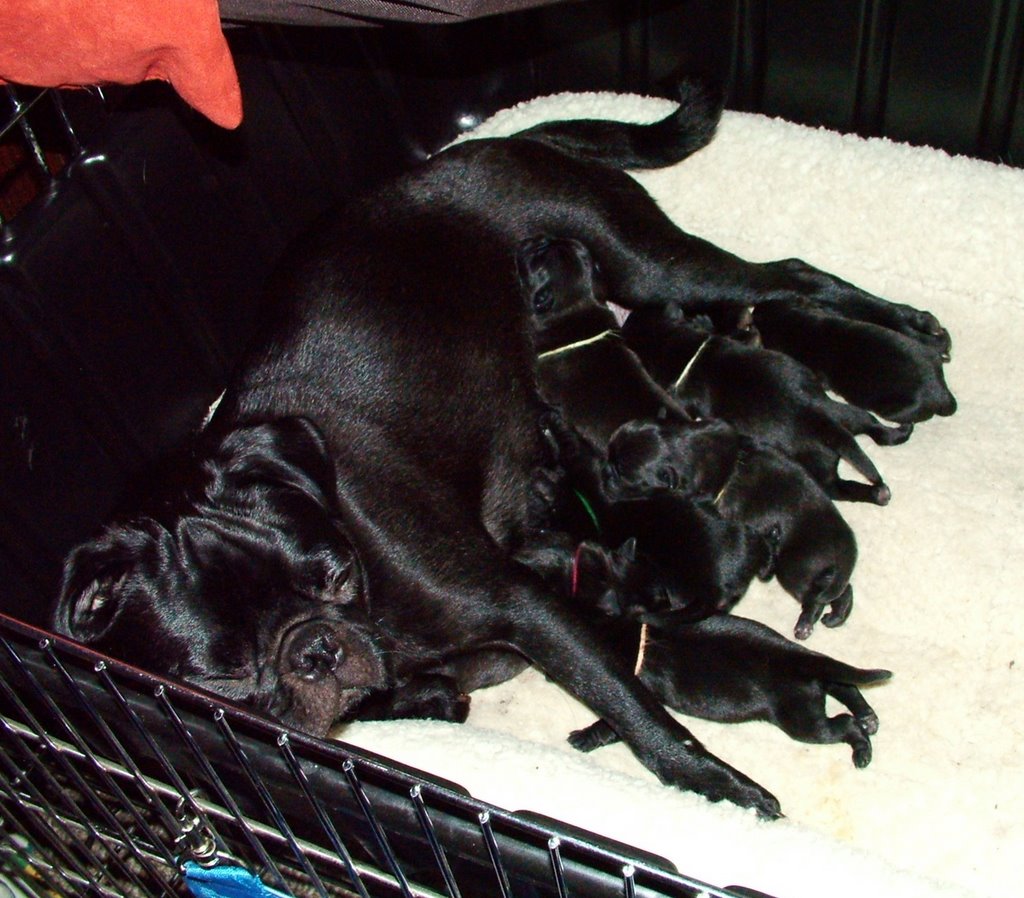
Petunia had her first litter of puppies! They were delivered on Thursday the 8th. She is a petite pug and we were worried about how many she could carry and whether or not she could deliver them naturally. On the previous Friday night, she started acting like she was going into labor, then nothing on Saturday, but we took her to the vet anyway. He confirmed that we still had a few days to go (we expected them on Tuesday) and he took x-rays. Found 5 puppies with an extra shadow that could have been a 6th. However, she was not to go past Thursday night. If the puppies hadn't come yet by Fri morning, she was to go in for a c-section.
Well, she waited and waited. I was already making arrangements for her to go in on Friday when she started into labor on Thursday morning. With the help of some homeopathic remedies to strengthen the uterus and to aid with contractions, she finally had the babies. Puppy #6 is nicknamed Shadow and puppy #7 is Surprise. All together there are 6 males and 1 female.
So can you count 7 puppies in the picture? Neither can we - lol! Try counting them at 2:30 in the morning when one of them is squealing and you're trying to make sure they're all ok.
Speaking of squealing - this litter has a runt. It's a cute little thing with a huge zest for life. Invariably it'll end up under one of the others and will shout his discomfort. So I'll rescue him and put him in the middle of the bed where at 3 days old, deaf (ears haven't opened) and blind, he'll squirm straight for momma's nipples and make it there in record time. He'll then make all sorts of contented noises while suckling and if another puppy crawls over him and steps on his head, he manages to squeal some more but never let go of that teat!! He's the only other one with a nickname so far. He came out of the sac looking like a 70 year old chinaman. Not too old, but somewhat aged and wise. I half expected him to recommend some ancient herbal remedies to me, but he just squawked his discomfort at being out in the big wide world.
Thursday, June 01, 2006
Trying to stay cool
Just a reminder to all those with flat-nosed breeds - keep them cool during the summer. Due to their short noses, they cannot cool themselves. Some things to keep in mind: get a kiddie pool and fill it with water for them to play in, keep plenty of water available, keep them inside during the heat of the day, give ice cubes as a treat, try cooling collars and mats, and never never never leave them in a car.
In honor of the start of summer, we installed a fountain in the back yard. They are not left outside during the heat of the day, but now that it's been there a few days and they've become accustomed to the sound of running water, they love it and get their drinks of water from it! Unfortunately, they also loved the impatiens surrounding it, so we may be left with just the fountain and gravel. But I guess that's ok, too.
In honor of the start of summer, we installed a fountain in the back yard. They are not left outside during the heat of the day, but now that it's been there a few days and they've become accustomed to the sound of running water, they love it and get their drinks of water from it! Unfortunately, they also loved the impatiens surrounding it, so we may be left with just the fountain and gravel. But I guess that's ok, too.
Wednesday, February 01, 2006
Pups are growing and more on the way!
Tiki's puppies are growing fast. With only 3 puppies surviving, they are getting more than their fair share of the milk. The two males are huge and are going to need some more exercise because momma is definitely catering to their every need. The little girl had a cold and fell behind the curve ball on gaining weight, but we hope she gains on them again soon.
Subscribe to:
Posts (Atom)


 Posts
Posts


